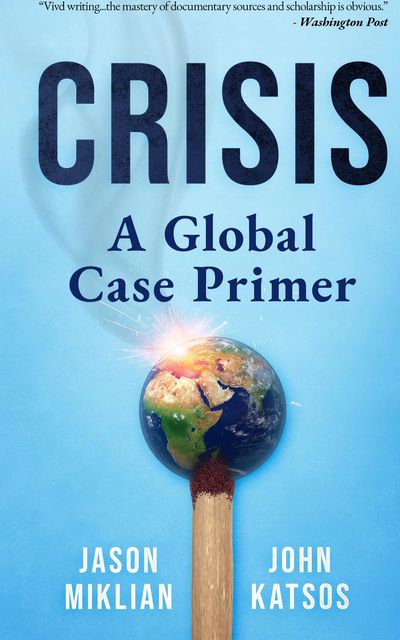
Responsible Management in Crisis: A Global Case Primer
Jason Miklian and John E. Katsos. Cambridge University Press, 2025. The casebook that follows Crisis: A Global Primer (2023), with the Force Majeure simulation as its classroom companion.
Crisis is a book about how businesses and people can better manage the reality of crisis, and better anticipate the challenges and opportunities that socio-political strife presents. It does so by pulling back the curtain on how business works in the toughest situations on earth.
Readers go on a global tour of business, from rebel-held coffee plantations in the jungles of Colombia and a factory amidst the urban battlefields of Iraq to diamond-studded Dubai resorts and stately London corporate nerve centers. Over 10 chapters, we walk through experiences as varied as how Ebola-stricken Liberia could have helped Facebook stop a genocide and what a brewery in New York can learn to manage social media outrage from a Venezuelan motorcycle repair shop.
These lessons can be distilled into our book’s three key lessons: business needs what we call a social license to operate effectively, companies need to embrace their roles as political actors, and leaders need to create crisis-proof company cultures by integrating values that counter the roots of crises.
The Uncertainty Doctrine also shows why businesses outside of conflict zones need to care about the lessons they teach us. The book traces how corporate decisions impact local populations and the bottom line, map what can and does go wrong, and show how firms that successfully navigate these challenges are more successful everywhere else.
This book is also a wake-up call to corporate leaders who think they can stay above the fray of contentious political issues. Crisis shows just how destructive this thinking can be. The question isn’t if a business will have to navigate through political and social issues, but when and how. These are not just questions about success - but about survival.
As academics with an insatiable curiosity for how the world really works, we have spent the last ten years studying businesses in some of the world’s worst war zones: Democratic Republic of Congo, Syria, Ukraine, Yemen, Venezuela, Liberia, Myanmar, Iraq, Colombia, Sri Lanka, the Former Yugoslavia, Lebanon. What kind of lunatics do that? The kind who needed to know how companies could possibly survive those situations. The kind who realized that if they could uncover the secret to their success, they'd have a once-in-a-lifetime insight to share.
The solutions aren’t easy - there’s no win-win back-patting nonsense in these pages - but over the long term they pay off almost every time. The good news is that the ‘hard path’ also happens to be the one that’s best for society too.